
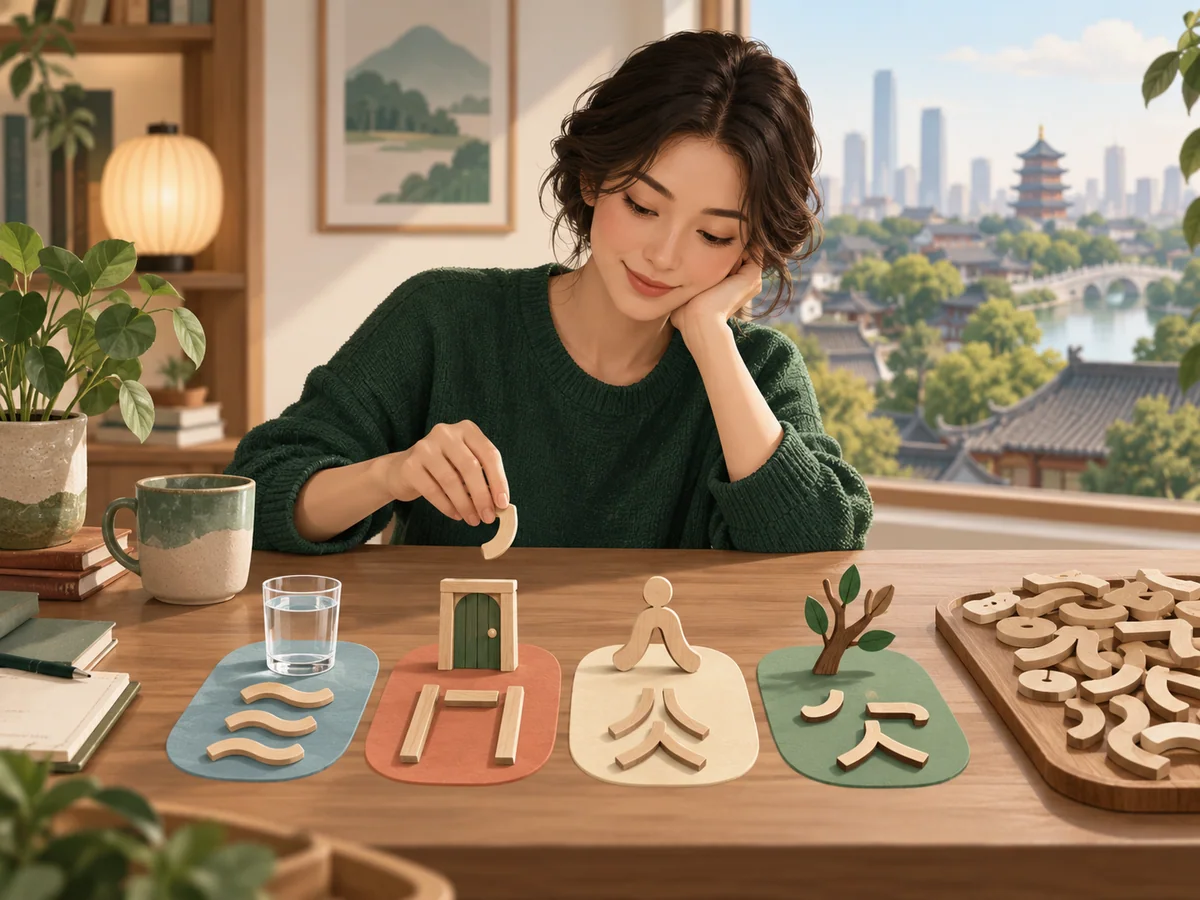
Stop memorising 214 radicals. Learn the 20 components that actually appear in signs, menus and forms — with real characters, a branching dialogue and a 7-day plan.
Learn 20 high-frequency components, not 214 radicals. Start with shapes that appear in words you already need: 口 in 入口, 氵 in 洗, 木 in 杯, 扌 in 推, 亻 in 你, 宀 in 家, 讠 in 请. Learn each one inside a real word, then use it to guess meaning or pronunciation when you meet a new character. That is enough to make signs, menus and forms less opaque without turning character study into a separate subject.
Why components beat a radical list
Radicals are dictionary categories. Components are the parts you actually see. A beginner does not need to know that 氵 is radical number 85; you need to see 洗 and think “water, washing.” The useful question is not “What is this radical called?” but “Where have I seen this shape before?”
Research on Chinese word learning during reading suggests that character-level information supports vocabulary acquisition when learners meet new words in context. The practical takeaway is not that you should memorise more isolated characters. It is that a small amount of form knowledge can make a new word easier to hold onto when you see it in a sentence or on a label. Character positional frequency and Chinese word learning during reading is relevant here because it points to how written form and word learning interact, not to a fixed number of components you must learn.
There is also evidence that how text is spaced affects new vocabulary acquisition for Chinese second-language readers. That does not mean you should redesign every sign you see. It means your study materials should make word boundaries clear, especially when you are learning from example sentences. Interword spacing and new vocabulary acquisition for Chinese L2 readers is a useful reminder that presentation matters, but your daily priority is still recognition in real contexts.
The 20 components worth your first month
These are not the only useful components. They are the ones that show up repeatedly in beginner-level signs, menus, forms and messages. Learn them as shapes with a rough meaning, not as a second vocabulary list.
mouth · kǒu · mouth: entrance · rùkǒu · entrance; exit · chūkǒu · exit; eat · chī · to eat.
氵 · shuǐ · water: 洗 · xǐ · to wash; 汤 · tāng · soup; 酒 · jiǔ · alcohol.
木 · mù · wood: 杯 · bēi · cup; 桌 · zhuō · table; 椅 · yǐ · chair.
扌 · shǒu · hand: 推 · tuī · to push; 拉 · lā · to pull; 找 · zhǎo · to look for.
亻 · rén · person: 你 · nǐ · you; 他 · tā · he; 住 · zhù · to live.
宀 · mián · roof: 家 · jiā · home; 安 · ān · safe; 室 · shì · room.
讠 · yán · speech: 请 · qǐng · please; 说 · shuō · to speak; 谢 · xiè · thanks.
女 · nǚ · woman: 妈 · mā · mother; 姐 · jiě · older sister; 好 · hǎo · good.
heart: to think; busy; fast.
日 · rì · sun/day: 明 · míng · bright; 早 · zǎo · early; 晚 · wǎn · late.
月 · yuè · moon/month: 朋 · péng · friend; 期 · qī · period; 服 · fú · clothing.
火 · huǒ · fire: 热 · rè · hot; 烧 · shāo · to burn; 灯 · dēng · lamp.
土 · tǔ · earth: 地 · dì · ground; 场 · chǎng · place; 坐 · zuò · to sit.
metal: 钱 · qián · money; 银 · yín · silver; 错 · cuò · wrong. · jīn · metal: 钱 · qián · money; 银 · yín · silver; 错 · cuò · wrong.
vehicle: 车 · chē · car; 转 · zhuǎn · to turn; 轻 · qīng · light.
door: 门 · mén · door; 问 · wèn · to ask; 间 · jiān · room. · mén · door: 门 · mén · door; 问 · wèn · to ask; 间 · jiān · room.
food: 饭 · fàn · rice/meal; 饿 · è · hungry; 馆 · guǎn · shop/restaurant. · shí · food: 饭 · fàn · rice/meal; 饿 · è · hungry; 馆 · guǎn · shop/restaurant.
艹 · cǎo · grass: 茶 · chá · tea; 菜 · cài · dish; 药 · yào · medicine.
纟 · sī · silk: 纸 · zhǐ · paper; 红 · hóng · red; 给 · gěi · to give.
movement: 这 · zhè · this; 边 · biān · side; 过 · guò · to pass.
Notice that some components give a meaning clue, some give a sound clue, and some do both imperfectly. 妈 · mā · mother contains 女 and 马 · mǎ · horse; the 马 part hints at the sound. That is a clue, not a rule. 好 · hǎo · good contains 女 and 子 · zǐ · child, but the meaning is not simply “woman” plus “child.” Treat every component as a hint you test against the word.
How to use components on signs, menus and forms
Start with places where a wrong guess has a cost. At a station, 入口 · rùkǒu · entrance and 出口 · chūkǒu · exit share 口. The first character changes the direction. At a restaurant, 茶 · chá · tea and 菜 · cài · dish share 艹. On a form, 请 · qǐng · please appears in 请问 · qǐngwèn · may I ask and 申请 · shēnqǐng · to apply. The component 讠 tells you the word is connected to speech or writing, not to a physical object.
Menus are a good training ground because the same components repeat. 汤 · tāng · soup has 氵. 饭 · fàn · rice or meal has 饣. 鸡 · jī · chicken and 鸭 · yā · duck share 鸟 · niǎo · bird, though 鸡 is simplified and does not look like a bird at first. You do not need to decode every dish. You need enough clues to ask a useful question.
Forms and notices are harder because they use formal vocabulary. 姓名 · xìngmíng · full name, 电话 · diànhuà · phone number and 地址 · dìzhǐ · address are worth recognising as whole words. Components help you tell them apart: 名 · míng · name contains 口, 话 · huà · speech contains 讠, and 址 · zhǐ · location contains 土. That is enough to avoid writing your phone number in the name box.
A branching dialogue: asking about a character you half-recognise
You are at a small shop and see a sign with 洗 · xǐ · wash. You are not sure if it means “wash” or something else.
You: Excuse me, what does this character mean?
Qǐngwèn, zhège zì shì shénme yìsi?
May I ask, what does this character mean?
Staff: 哪个字?
Nǎge zì?
Which character?
You: The one on the left with the three-dot water radical. The 洗 in 洗衣服?
Zuǒbiān yǒu sāndiǎnshuǐ de nàge. Xǐ yīfu de xǐ ma?
The one with the three-dot water on the left. Is it the xǐ in “wash clothes”?
Staff: Yes, the restroom is over there.
Duì, xǐshǒujiān zài nàbiān.
Yes, the washroom is over there.
If the staff member uses a word you do not know, do not panic. Point to the character and repeat the part you recognise.
You: I don't recognize this character, but I know the water radical. Is it related to water?
Wǒ bú rènshi zhège zì, dànshì wǒ zhīdào sāndiǎnshuǐ. Shì gēn shuǐ yǒuguān ma?
I do not know this character, but I know the three-dot water. Is it related to water?
Staff: Right, generally yes. 洗, 汤, 酒 all have the three-dot water radical.
Duì, yìbān shì. Xǐ, tāng, jiǔ dōu yǒu sāndiǎnshuǐ.
Yes, usually. 洗, 汤 and 酒 all have the three-dot water.
This is the real skill: not reciting a radical list, but asking a specific question about a shape you have noticed. The phrase 三点水 · sāndiǎnshuǐ · three-dot water is common in China when people describe characters. Regional and workplace habits vary, but pointing at the character and naming the component is widely understood.
What components will not do for you
Components will not tell you the tone. 妈 · mā · mother and 马 · mǎ · horse share a shape, but the tones differ. They will not always give you the meaning. 错 · cuò · wrong contains 金, but “wrong” is not a metal. They will not replace vocabulary. If you know 氵 but not 洗, you still cannot read 洗手间 · xǐshǒujiān · washroom as a whole.
They also vary in usefulness by region and context. A menu in a tourist area may use more pictures and English. A local canteen may use handwritten characters that look different from the printed forms you studied. A workplace form may use abbreviations you have not seen. Components are a recognition aid, not a decoding machine.
The honest limitation is this: components help most when you already know some words. If your vocabulary is zero, 氵 will not save you. If you know 洗 and 手, then 洗手间 becomes guessable. Build both at the same time.
Seven days of component practice
Day 1: Learn 口, 氵 and 木. Find them in 入口, 洗 and 杯. Say each word aloud once.
Day 2: Add 扌, 亻 and 宀. Look for 推, 拉, 你, 他, 家 and 安 on signs or in your phone.
Day 3: Add 讠 and 女. Write 请, 说, 谢, 妈 and 姐. Notice which parts repeat.
Day 4: Add 心, 日 and 月. Read 想, 忙, 明, 早, 朋 and 期. Do not worry about stroke order yet.
Day 5: Add 火, 土 and 金. Find 热, 地, 钱 and 错 in a menu, a form or a payment screen.
Day 6: Add 车, 门 and 饣. Read 车, 问, 间, 饭 and 饿. Then cover the English and test yourself.
Day 7: Add 艹, 纟 and 辶. Read 茶, 菜, 纸, 红, 这, 边 and 过. Pick five words you actually saw this week and write one sentence with each.
After seven days, do not start a new list. Reuse these 20 components in real reading. Next time you see a sign, ask: which component do I recognise, and what does that suggest? If you cannot answer, photograph the sign and look it up later. The goal is not to finish a radical chart. It is to make the next sign slightly less silent.