
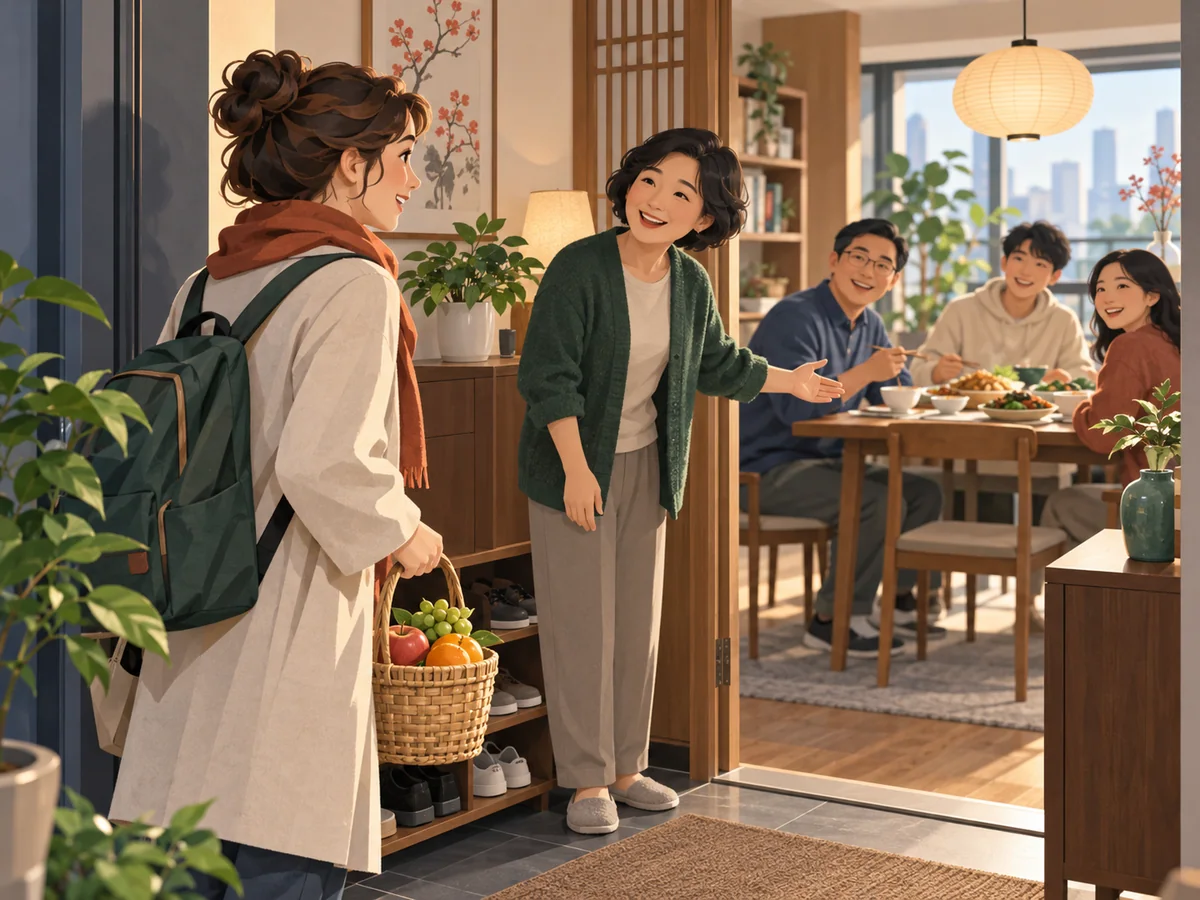
A practical, non-mystical guide to visiting a Chinese home: what gift actually works, when to arrive, how to handle shoes and food offers, what to say, and how to leave well.
Bring a small gift, arrive on time or a few minutes late, take your shoes off if the entry suggests it, and accept at least a token amount of food. Say 阿姨好 (ā yí hǎo · hello, auntie) or 您好,打扰了 (nín hǎo, dǎ rǎo le · hello, sorry to disturb you). Give and receive with two hands. Don't refuse food outright; say you're full but will have a little. Leave after tea or fruit, thank the host, and message later that you got home safely.
Current-reference check: We verified the practical framework against A Guide to Working and Living in China as Business Expatriates (2025 Edition). Local procedures can change, so confirm time-sensitive details with the service you use. It provides the broader newcomer context; the host relationship, region and occasion should still guide what you bring.
What to bring (and what to avoid)
Fruit is the default. A bag of good oranges, grapes, or seasonal fruit from a nearby shop is almost never wrong. Tea works if you know the household drinks it. A box of pastries or a small regional specialty from your own country is fine if it's not too heavy or too weird. The point is not impressiveness; it's that you didn't come empty-handed.
Two hands matter more than price. Hand the bag over with both hands and a short line: 一点心意 (yì diǎn xīn yì · just a small token). The host may say 不用不用 (bú yòng bú yòng · no need, no need). That's a ritual, not a rejection. Keep holding it out; they'll take it.
Avoid clocks (sòng zhōng sounds like attending a funeral), sharp objects like knives or scissors, and very expensive gifts unless you know the family well. In some regions, pears (lí) are avoided because the word sounds like separation, but this varies by family and generation. If you're unsure, fruit and tea are safe. If you're visiting a colleague's parents, a modest gift is enough; don't try to match what a close relative would bring.
When to arrive, and what to do at the door
Arrive on time, or five to ten minutes late. Arriving early can catch the host still cooking or cleaning. If you're meeting a group, arriving a few minutes after the stated time is normal in many social settings, but for a formal dinner with a boss or elder, be on time. If you're delayed, send a message: 我晚点到,大概十分钟 (wǒ wǎn diǎn dào, dà gài shí fēn zhōng · I'll be a bit late, about ten minutes).
At the door, wait to be invited in. If you see a row of shoes outside or a shoe rack inside, ask 要换鞋吗?(yào huàn xié ma? · should I change shoes?). The host will say 不用 or 换一下吧. Follow their answer. If they offer slippers, put them on. Don't walk past the entry in outdoor shoes if the floor is clearly a shoe-free zone.
Hand over your gift before you sit down. Say 阿姨好/叔叔好 (ā yí hǎo / shū shu hǎo) if you're addressing friends' parents. For a general host, 您好,打扰了 (nín hǎo, dǎ rǎo le) is enough. Then follow them to the living room. Don't wander.
Food offers: how to accept, how to limit
Food will appear. Tea, fruit, nuts, sometimes a full meal. Accept something. Holding a cup of tea is part of the visit. If you're full, say 我吃饱了,再吃一点 (wǒ chī bǎo le, zài chī yì diǎn · I'm full, but I'll have a little). That gives you a small portion without refusing the gesture.
If you really can't eat something—allergy, diet, or you just dislike it—say 我吃不了这个 (wǒ chī bu liǎo zhè ge · I can't eat this) and move on. Don't launch into a long explanation unless asked. A simple 谢谢,我不吃这个 (xiè xie, wǒ bù chī zhè ge · thanks, I don't eat this) is fine.
When the host pours tea, tap two fingers on the table if you want to signal thanks without interrupting. This is common in southern China and among tea-drinking families, but not universal. If you don't know it, a small nod and 谢谢 works everywhere.
Praise, compliments, and the two-hands rule
Compliment the food, not the wealth. 这个菜真好吃 (zhè ge cài zhēn hǎo chī · this dish is really delicious) is safe. 你家好大 (nǐ jiā hǎo dà · your home is so big) can sound like you're measuring their money. If you want to praise the home, say 家里很舒服 (jiā lǐ hěn shū fu · the home feels very comfortable).
Compliment responses in Chinese often involve deflecting or downgrading the praise. A host may say 哪里哪里 (nǎ lǐ nǎ lǐ · where, where) or 一般一般 (yì bān yì bān · just so-so). This is not false modesty; it's a conversational norm. Don't argue. Smile and move on. If you're the one being praised, a simple 谢谢 is increasingly common among younger people, but older hosts may still deflect. Follow their lead.
Use two hands when giving or receiving anything: a gift, a cup, a business card, a plate. One hand is casual; two hands is respectful. This applies to both hands on the object or one hand supporting the other wrist. It's a small physical habit that reads as good manners.
Helping, sitting, and the bathroom question
Offer to help once. 要我帮忙吗?(yào wǒ bāng máng ma? · do you want help?) The host will almost certainly say no. That's fine. If they say yes, do the small task they give you. Don't start washing dishes unless they insist. In many homes, the kitchen is the host's territory, and a guest doing too much can feel awkward.
Sit where you're told. If there's a sofa and a chair, wait to be directed. Don't put your feet on the coffee table. Don't open closed doors. If you need the bathroom, ask 洗手间在哪里?(xǐ shǒu jiān zài nǎ lǐ? · where is the bathroom?).
If you're staying for a meal, wait for the eldest or the host to start eating before you pick up your chopsticks. This is a general norm, but families vary. If you're unsure, watch what others do and follow.
Leaving well: timing, thanks, and the follow-up message
Leave after tea or fruit, or after the meal winds down. Don't be the last guest unless you're close. Say 我先走了 (wǒ xiān zǒu le · I'll head off first) or 时间不早了,我该走了 (shí jiān bù zǎo le, wǒ gāi zǒu le · it's getting late, I should go). Thank the host: 谢谢你们的招待 (xiè xie nǐ men de zhāo dài · thanks for having me).
The host may walk you to the door or elevator. Accept it. Don't make them walk you all the way to the street unless they offer. Once you're home, send a short message: 我到家了,谢谢今晚的招待 (wǒ dào jiā le, xiè xie jīn wǎn de zhāo dài · I got home, thanks for tonight's hospitality). This is expected and appreciated.
If you brought a gift, you may not see it opened. That's normal. Don't ask if they liked it. If they mention it later, a simple 喜欢就好 (xǐ huān jiù hǎo · glad you like it) closes the loop.
A branching dialogue: arriving with a gift
You: Hello auntie, sorry to disturb you. This is a small token. (ā yí hǎo, dǎ rǎo le. zhè shì yì diǎn xīn yì · Hello auntie, sorry to disturb you. This is a small token.)
Host: 哎呀,来就来嘛,还带什么东西。快进来。 (āi yā, lái jiù lái ma, hái dài shén me dōng xi. kuài jìn lái · Oh, you didn't have to bring anything. Come in.)
You: Should I change shoes? (yào huàn xié ma?)
Host: 不用不用,直接进来吧。 (bú yòng bú yòng, zhí jiē jìn lái ba · No need, just come in.)
You: Your home feels very comfortable. (jiā lǐ hěn shū fu · Your home feels very comfortable.)
Host: 哪里哪里,随便坐。喝茶吗? (nǎ lǐ nǎ lǐ, suí biàn zuò. hē chá ma? · Not at all, sit anywhere. Tea?)
You: 好,谢谢。 (hǎo, xiè xie · Yes, thanks.)
If the host insists on shoes off, say 好的 (hǎo de · okay) and change. If they offer food you can't eat, use 我吃不了这个,谢谢 (wǒ chī bu liǎo zhè ge, xiè xie · I can't eat this, thanks). If you need to leave early, say 我还有点事,先走了 (wǒ hái yǒu diǎn shì, xiān zǒu le · I have something to do, I'll head off first).
Your next three visits: a practice plan
Visit 1: Bring fruit and use two hands. Buy a bag of oranges or grapes. At the door, say 阿姨好/叔叔好 and hand it over with both hands. Use 一点心意. Stay for tea. Leave after one cup. Send 我到家了,谢谢.
Visit 2: Practice food offers. When food appears, accept a small portion with 我吃饱了,再吃一点. If you can't eat something, say 我吃不了这个. Compliment one dish with 这个菜真好吃. Watch how the host responds to praise.
Visit 3: Handle the exit. Set a mental time limit. When you're ready, say 时间不早了,我该走了. Thank the host with 谢谢你们的招待. Follow up with a message. Notice whether they walk you to the door or elevator, and mirror that next time.
If you're visiting a colleague's parents in a smaller city, expect more food pushing and more questions about your age and salary. In a big-city apartment among younger friends, the visit may be looser: shoes on, snacks out, no formal seating. Read the room, keep the two-hands habit, and don't treat any single script as universal.