
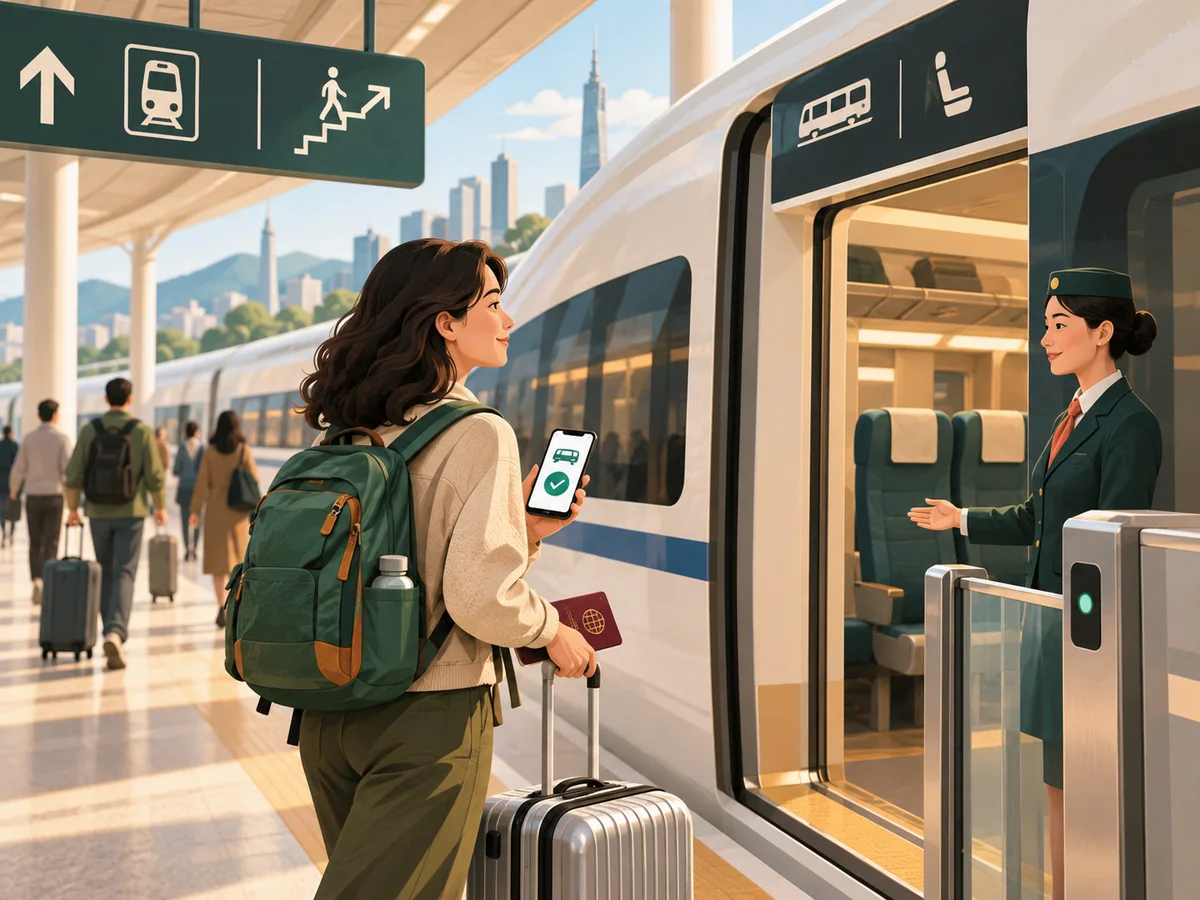
Passport checks, gates, seat swaps, missed trains: the exact Mandarin lines you need for a Chinese high-speed rail trip, with a branching dialogue and a 7-day drill.
Buy a ticket, scan your passport, find the gate, board the right carriage, sit in the right seat. That is the whole job. The Mandarin below covers each step, plus the two situations that actually derail beginners: a seat that is already taken and a train you have just missed. Learn the six lines in bold first; they carry most of the trip.
Before the station: passport, ticket and the 12306 app
Foreign passengers usually book with a passport, not a Chinese ID. On 12306, add your passport details exactly as they appear on the document. At the station, the same passport is your ticket. If you are buying at a window, the first line is:
I want a high-speed train ticket to Beijing. · wǒ yào yī zhāng qù Běijīng de gāotiě piào · I want one high-speed ticket to Beijing.
For a return or a specific time, add 往返 (wǎngfǎn · round trip) or 下午三点 (xiàwǔ sān diǎn · 3 p.m.). If you are not sure which station in a multi-station city, ask 哪个站?(nǎge zhàn? · which station?). In Shanghai, for example, 上海虹桥 (Shànghǎi Hóngqiáo) and 上海站 (Shànghǎi Zhàn) are different places. The official guide for business expatriates notes that foreigners should carry their passport for identity checks during travel, so keep it accessible rather than buried in a bag (A Guide to Working and Living in China as Business Expatriates, 2025 Edition).
At the gate: the four phrases that get you through
Station entry is a sequence: security scan, ticket check, waiting hall, gate. Staff may ask for your passport or ticket. Hand both over and say:
This is my passport and ticket. · zhè shì wǒ de hùzhào hé chēpiào · This is my passport and ticket.
If a gate is not open yet, the screen shows a waiting time. If you cannot find the gate, ask 请问,G1234在哪个检票口?(qǐngwèn, G1234 zài nǎge jiǎnpiàokǒu? · Excuse me, which gate is G1234?). The answer will be a number plus 检票口 (jiǎnpiàokǒu · ticket gate). Listen for 开始检票 (kāishǐ jiǎnpiào · now boarding) and 停止检票 (tíngzhǐ jiǎnpiào · boarding closed). The second one is the phrase that ends your trip if you are still in the queue.
On the platform: carriage, seat and the quiet argument
Chinese high-speed platforms mark carriage numbers on the ground. Find your carriage number before the train arrives. On board, your ticket shows carriage and seat, for example 07车12A (qī chē shí'èr A · carriage 7, seat 12A). If someone is in your seat, do not open with a complaint. Open with the ticket:
不好意思,这是我的座位。 · bù hǎoyìsi, zhè shì wǒ de zuòwèi · Sorry, this is my seat.
Then show your ticket or the 12306 order. Most seat conflicts are honest mistakes, often because two people boarded at different stations. If the other passenger insists, call a attendant: 请帮我一下 (qǐng bāng wǒ yīxià · please help me). Do not escalate physically; staff handle seat disputes routinely.
Changing seats, changing trains, and the missed-train window
If you want a different seat on the same train, ask the attendant:
I would like to change seats.
If you need a different train or date, the verb is 改签 (gǎiqiān · to rebook/change ticket). At a ticket window: 我想改签。 (wǒ xiǎng gǎiqiān · I want to change my ticket.) If you have missed the train, say it plainly and ask what is possible:
I missed my train. Can I change the ticket? · wǒ cuòguò le wǒ de huǒchē. kěyǐ gǎiqiān ma? · I missed my train. Can I change it?
Rules and fees vary by ticket type and how late you are, so treat any answer as station-specific. Do not assume a missed train is automatically refundable.
A branching dialogue: seat taken, then a missed connection
You: 不好意思,这是我的座位。 · bù hǎoyìsi, zhè shì wǒ de zuòwèi · Sorry, this is my seat.
Passenger: Which seat is yours? · nǐ de zuòwèi shì nǎge? · Which seat is yours?
You: 07车12A。 · qī chē shí'èr A · Carriage 7, 12A.
Passenger: 哦,我看错了。对不起。 · ó, wǒ kàn cuò le. duìbuqǐ · Oh, I misread. Sorry.
Later, you realize you are on the wrong train and it is already moving. You find the attendant:
You: Excuse me, does this train go to Nanjing South Station? · qǐngwèn, zhè tàng chē dào Nánjīng Nán Zhàn ma?
Attendant: 不到。这是去杭州的。 · bù dào. zhè shì qù Hángzhōu de · No. This one goes to Hangzhou.
You: Then what should I do? · nà wǒ yīnggāi zěnme bàn? · Then what should I do?
Attendant: 下一站下车,找站长改签。 · xià yī zhàn xià chē, zhǎo zhànzhǎng gǎiqiān · Get off at the next stop and ask the station master to rebook you.
This is not a script for every outcome, but it gives you the two moves that matter: state the problem, ask what to do next.
Useful lines to keep on your phone
1. 我要一张去北京的高铁票。 · wǒ yào yī zhāng qù Běijīng de gāotiě piào · One high-speed ticket to Beijing.
2. Excuse me, which gate is G1234? · qǐngwèn, G1234 zài nǎge jiǎnpiàokǒu? · Which gate is G1234?
3. This is my passport and ticket. · zhè shì wǒ de hùzhào hé chēpiào · This is my passport and ticket.
4. Where is carriage 7? · qī chē zài nǎlǐ? · Where is carriage 7?
5. Sorry, this is my seat. · bù hǎoyìsi, zhè shì wǒ de zuòwèi · Sorry, this is my seat.
6. I want to change seats. · wǒ xiǎng huàn zuòwèi · I want to change seats.
7. I want to change my ticket. · wǒ xiǎng gǎiqiān · I want to change my ticket.
8. I missed my train. · wǒ cuòguò le wǒ de huǒchē · I missed my train.
9. Does this train go to Nanjing South Station? · zhè tàng chē dào Nánjīng Nán Zhàn ma? · Does this train go to Nanjing South Station?
10. Excuse me, where is the restroom? · qǐngwèn, xǐshǒujiān zài nǎlǐ? · Excuse me, where is the restroom?
11. Can you help me? · kěyǐ bāng wǒ yīxià ma? · Can you help me?
Seven days, three real uses
Day 1: read the eleven lines aloud twice, then cover the English and say each from the pinyin. Day 2: practise the branching dialogue with a partner, switching roles. Day 3: open 12306 or a ticket app and read your own upcoming trip aloud in Chinese: carriage, seat, station, time. Day 4: record yourself saying lines 1, 2 and 5; listen for tone pairs, especially 车票 (chēpiào) and 座位 (zuòwèi). Day 5: write a three-line script for your actual journey. Day 6: rehearse the missed-train line until it is automatic. Day 7: at the station, use at least three lines with staff or a passenger. If you have no trip this week, use the lines at a ticket window anyway: ask for a train to a nearby city, then ask which station it leaves from. The goal is not perfect grammar; it is being understood at the gate, in the carriage and at the window when something goes wrong.