
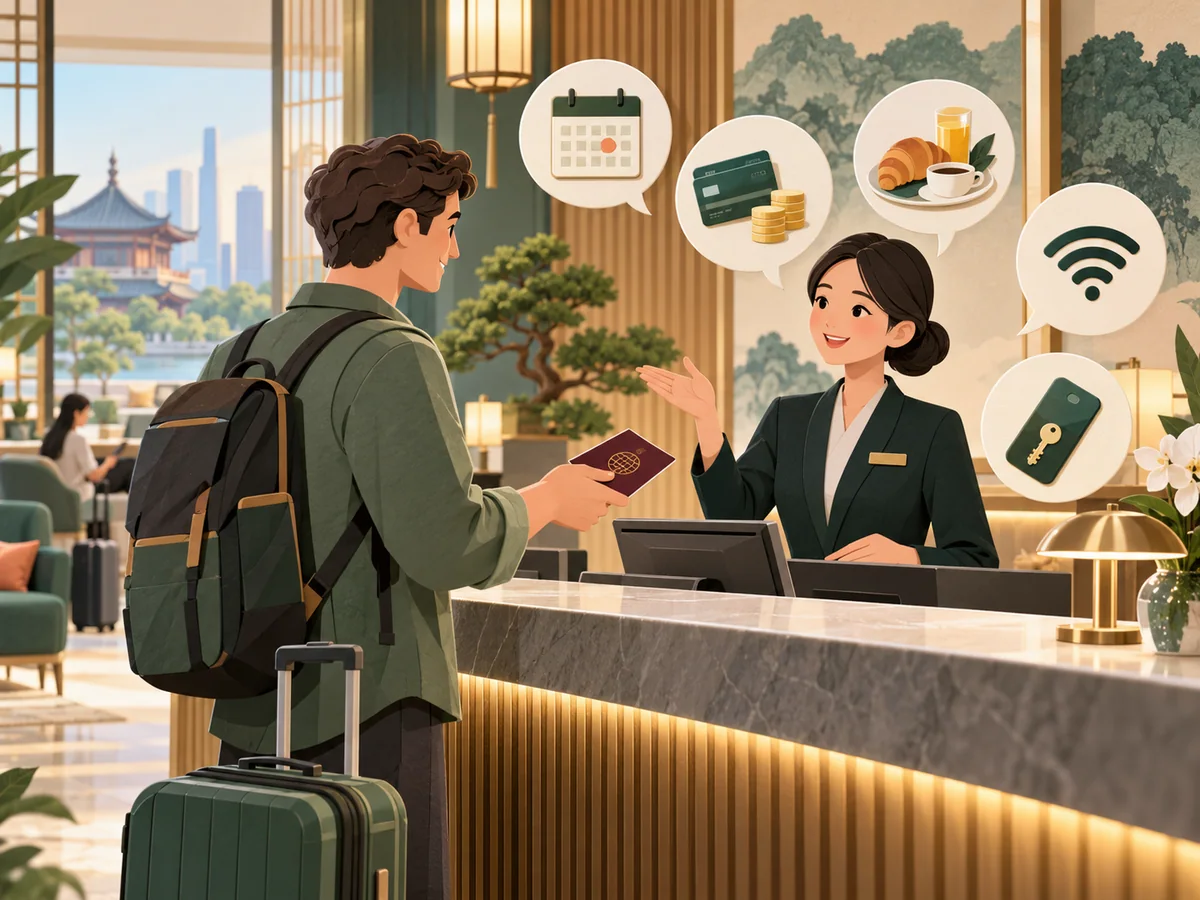
A predictable hotel check-in script for China: passport, deposit, breakfast times, Wi-Fi, and fixes for a missing booking or a bad room. Say each line once, then listen for the number.
At a Chinese hotel front desk, you need roughly eight sentences: passport handover, booking name, deposit, breakfast time, Wi-Fi password, and two problem fixes. You do not need to understand every reply. Say your line, then listen for one number or one yes/no. The script below is ordered the way a real check-in unfolds, with a branching path when something goes wrong.
Before you reach the desk: two lines that save time
Have your passport and booking confirmation open on your phone before you join the queue. The first line is simply Hello, I'd like to check in. · nǐ hǎo, wǒ yào bàn rùzhù · “Hello, I want to check in.” If the queue is long, Excuse me, is check-in here? · qǐngwèn, bàn rùzhù shì zài zhèlǐ ma? · “Excuse me, is check-in here?” works at larger properties where the front desk is split into sections.
If you booked under a Chinese name — a colleague, a travel agent, or a Chinese friend — say that name slowly. If you booked under your passport name, say I booked a room, the name is... · wǒ dìng le fángjiān, míngzi shì… · “I booked a room, the name is…” Then show the confirmation screen. Staff will usually find the booking faster from the screen than from your pronunciation.
The passport and registration moment
Hand over your passport and say This is my passport · zhè shì wǒ de hùzhào · “This is my passport.” Hotels in China register foreign guests with local police, and the front desk will scan the passport and may ask you to sign a registration form. The 2025 business-expat guide notes that foreigners must register their residence with local police within 24 hours of arrival if staying in a private home, but hotels handle this registration for you — you only need the passport. A Guide to Working and Living in China as Business Expatriates (2025 Edition).
If you are traveling with a colleague who booked the room, say He booked the room · fángjiān shì tā dìng de · “He booked the room.” Point to the colleague. This prevents the desk from assuming you are the only guest and asking for a second passport that is not there.
Deposit: the number you need to hear
The deposit line is How much is the deposit? · yājīn shì duōshao? · “How much is the deposit?” Listen for a number, usually in the hundreds. If you want to pay by card, say 可以刷卡吗? · kěyǐ shuākǎ ma? · “Can I pay by card?” If you prefer mobile payment, 可以用微信吗? · kěyǐ yòng Wēixìn ma? · “Can I use WeChat?” Most city hotels accept both, but small guesthouses may ask for cash.
If the deposit feels high, you can ask Can the deposit be a bit less? · yājīn kěyǐ shǎo yīdiǎn ma? · “Can the deposit be a little less?” The answer may be no, and that is normal. Do not argue; the deposit is usually refunded at check-out after the room is inspected. Ask Is the deposit refunded at check-out? · tuìfáng de shíhou tuì yājīn ma? · “Is the deposit refunded at check-out?”
Breakfast, Wi-Fi, and the two numbers that matter
For breakfast, ask What time does breakfast start? · zǎocān jǐ diǎn kāishǐ? · “What time does breakfast start?” and Where is breakfast? · zǎocān zài nǎlǐ? · “Where is breakfast?” Listen for a floor number and a time. If breakfast is included, the desk may say 含早餐 · hán zǎocān · “breakfast included.” If not, How much is breakfast? · zǎocān duōshao qián? · “How much is breakfast?”
For Wi-Fi, say Wi-Fi 密码是多少? · Wi-Fi mìmǎ shì duōshao? · “What is the Wi-Fi password?” If the reply is a string of letters and numbers you cannot catch, hand over your phone with the Wi-Fi settings open and say Please enter it for me · qǐng bāng wǒ shūrù · “Please type it in for me.” This is faster and less embarrassing than asking three times.
Branching dialogue: when the booking is missing or the room is wrong
This is the part most beginners fear. Stay with the same rhythm: state the problem, then ask for the fix.
You: Hello, I booked a room, but I can't find my booking. · nǐ hǎo, wǒ dìng le fángjiān, dànshì zhǎo bù dào wǒ de yùdìng. · “Hello, I booked a room, but I can't find my booking.”
Desk: “What name did you book under?”
You: 用护照订的。这是确认单。 · yòng hùzhào dìng de. zhè shì quèrèn dān. · “Under my passport. This is the confirmation.”
Desk: Please wait a moment, I will check. · qǐng shāo děng, wǒ chá yīxià.
Desk: Found it, but the room type is different. · zhǎo dào le, dànshì fángxíng bù yīyàng. · “Found it, but the room type is different.”
You: 可以换一间一样的房间吗? · kěyǐ huàn yī gè yīyàng de fángjiān ma? · “Can you change it to the same room type?”
Desk: Not today, tomorrow we can change. · jīntiān méiyǒu, míngtiān kěyǐ huàn. · “Not today, tomorrow we can change.”
You: Okay, change tomorrow. Thank you. · hǎo de, míngtiān huàn. xièxie. · “Okay, change tomorrow. Thank you.”
If the room itself is the problem — noise, smell, no hot water — call the front desk and say The room is a bit noisy · fángjiān yǒudiǎn chǎo · “The room is a bit noisy” or 没有热水 · méiyǒu rèshuǐ · “There is no hot water.” Then ask 可以换房间吗? · kěyǐ huàn fángjiān ma? · “Can I change rooms?” If you want someone to come up, say 可以上来看一下吗? · kěyǐ shànglái kàn yīxià ma? · “Can someone come up and take a look?”
Checking out without a surprise
At check-out, say I want to check out · wǒ yào tuìfáng · “I want to check out.” If you took anything from the minibar, mention it: I drank the water in the fridge · wǒ hē le bīngxiāng lǐ de shuǐ · “I drank the water in the fridge.” Then ask Where is the deposit refunded to? · yājīn tuì dào nǎlǐ? · “Where is the deposit refunded?” The answer is usually back to the same card or payment app. If you need a receipt, say 可以开发票吗? · kěyǐ kāi fāpiào ma? · “Can I get a receipt?” This matters if you are traveling for work.
One honest limitation: hotel English levels vary. In international chains in Beijing, Shanghai, and Guangzhou, staff often switch to English the moment they hear your accent. In smaller cities or budget hotels, they may not. Your script still works — keep sentences short, show your phone, and let the numbers do the work.
Next three uses: a seven-day practice plan
Day 1: Write the eight core lines on your phone notes: 办入住, 护照, 押金, 早餐几点, Wi-Fi 密码, 换房间, 退房, 发票. Read them aloud once each.
Day 2: Record yourself saying the deposit question and the Wi-Fi question. Play it back and check that the tones on 押金 (yājīn) and 密码 (mìmǎ) are clear.
Day 3: Practice the branching dialogue with a friend or language app. One person plays the desk and gives a different answer each time — “no room,” “different room type,” “deposit is 500.”
Day 4: Listen to a Chinese number range out loud: 100, 200, 300, 500, 800. Hotel deposits and breakfast prices fall in this range.
Day 5: Rehearse the problem lines: 房间有点吵, 没有热水, 可以换房间吗. Say each twice, calmly.
Day 6: Simulate a check-out. Say 我要退房, then answer 押金退到哪里 with 退到原来的卡里 (tuì dào kǎ lǐ · “back to the card”).
Day 7: Use the script at a real hotel, even if you only say the first two lines. The goal is not fluency; it is finishing the transaction without switching to English. Next three uses: check in, ask for Wi-Fi, and check out. Each time, add one new line you did not use before.