A pharmacy phrasebook for new arrivals: describe simple symptoms, check allergies, read dosage labels, and know when to see a doctor—without pretending language help is medical advice.
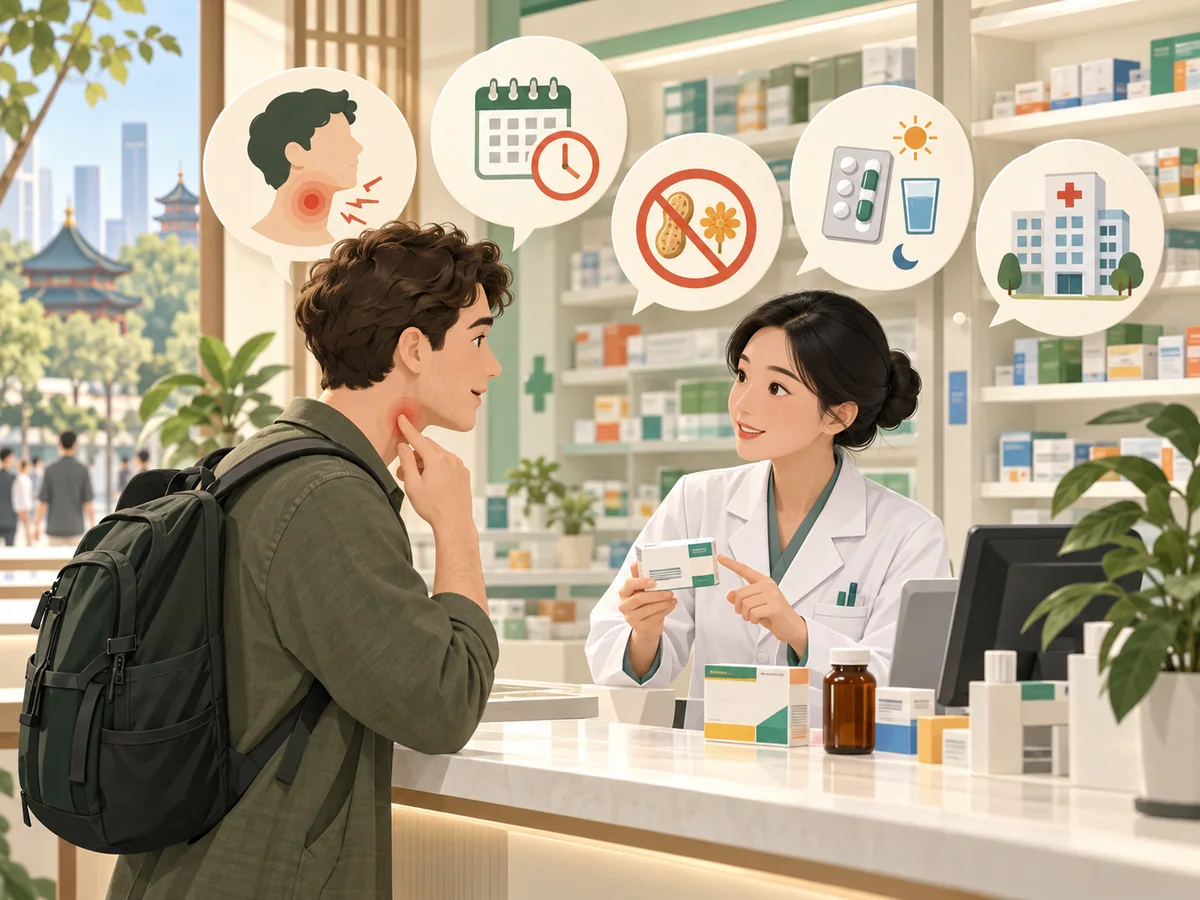
Go to the counter, say what is wrong in one short sentence, then give the duration. For a common cold, start with 我感冒了,三天了 (Wǒ gǎnmào le, sān tiān le) — I have a cold, it has been three days. Add one key detail such as fever, cough, or allergy. If you are not sure what you need, ask 有什么建议吗? (Yǒu shénme jiànyì ma?) — Do you have any suggestions? Keep it simple; the pharmacist will ask follow-up questions.
Before you speak: what a pharmacy can and cannot do
In China, pharmacies sell prescription and over-the-counter medicines, and staff often help with minor symptoms. They can check a dosage label, suggest a common remedy, or tell you to see a doctor. They are not a substitute for a diagnosis. If you have chest pain, trouble breathing, a high fever that will not come down, or symptoms that are severe or unusual for you, go to a clinic or hospital rather than trying to manage it at a counter.
The language goal is narrow: describe a simple symptom, give a duration, state an allergy, confirm how to take the medicine, and understand a referral. You do not need medical vocabulary to do this well. You need clear, short sentences and the confidence to repeat numbers back.
Ten lines for the counter
Use these as building blocks. Replace the symptom or duration as needed. Speak slowly; staff are used to hearing accented Mandarin.
- I have a cold.
- My throat hurts.
- I have a cough, it has been three days.
- I have a headache.
- I have a fever.
- My stomach hurts.
- I have a runny nose.
- I am allergic to …
- I am allergic to penicillin.
- Is there another medicine? (Yǒu bié de yào ma?) — Is there another medicine?
If you need to slow the conversation down, say 请说慢一点 (Qǐng shuō màn yìdiǎn) — please speak a little slower. If you do not understand, 我没听懂 (Wǒ méi tīngdǒng) — I did not understand.
A branching dialogue: cold symptoms at the counter
This is a realistic exchange. The pharmacist’s questions branch based on your answers. Read it aloud once, then swap the symptom.
You: Hello, I have a cold, it has been three days. (Nǐ hǎo, wǒ gǎnmào le, sān tiān le.) — Hello, I have a cold, it has been three days.
Pharmacist: Do you have a fever? (Fāshāo ma?) — Do you have a fever?
You: 不发烧,但是咳嗽。 (Bù fāshāo, dànshì késòu.) — No fever, but I have a cough.
Pharmacist: Is there phlegm? (Yǒu tán ma?) — Is there phlegm?
You: 没有。 (Méiyǒu.) — No.
Pharmacist: Are you allergic to any medicine? (Nǐ duì shénme yào guòmǐn ma?) — Are you allergic to any medicine?
You: I am allergic to penicillin.
Pharmacist: This medicine: twice a day, one tablet each time. (Zhège yào yì tiān liǎng cì, yí cì yí piàn.) — This medicine: twice a day, one tablet each time.
You: 一天两次,一次一片。对吗? (Yì tiān liǎng cì, yí cì yí piàn. Duì ma?) — Twice a day, one tablet each time. Is that right?
Pharmacist: Correct. If it is not better in three days, go to the hospital. (Duì. Rúguǒ sān tiān bù hǎo, qù yīyuàn.) — Correct. If it is not better in three days, go to the hospital.
You: Okay, thanks. (Hǎo de, xièxie.) — Okay, thank you.
Safety note: The dosage in this dialogue is only a language example, not medical advice. Follow the package instructions and the directions of a qualified pharmacist or doctor.
Safety note: The dosage in this dialogue is only a language example, not medical advice. Follow the package instructions and the directions of a qualified pharmacist or doctor.
Notice the branch: if you had said 发烧 (fāshāo), the pharmacist might ask how high, or suggest a fever reducer. If you had said 有痰 (yǒu tán), the conversation could shift to a different cough medicine. Your allergy answer changes what they offer.
Duration, severity, and the one detail that changes the recommendation
Duration is the fastest way to move from vague to useful. Put the time at the end: 两天了 (liǎng tiān le) — it has been two days; 一周了 (yì zhōu le) — it has been a week. For severity, keep it simple: 很疼 (hěn téng) — very painful; 有点疼 (yǒudiǎn téng) — a little painful. If you are not sure, say 不太严重 (bú tài yánzhòng) — not too serious.
The detail that most often changes a recommendation is allergy, followed by pregnancy, breastfeeding, or a chronic condition. If any apply, say them early. 我怀孕了 (Wǒ huáiyùn le) — I am pregnant. 我在哺乳期 (Wǒ zài bǔrǔqī) — I am breastfeeding. 我有高血压 (Wǒ yǒu gāoxuèyā) — I have high blood pressure. These are not diagnoses; they are safety flags.
Reading the dosage label without guessing
Dosage labels use a small set of patterns. Learn to spot 一天 (yì tiān, per day), 次 (cì, times), 片 (piàn, tablets), and 毫升 (háoshēng, milliliters). A label might read 一天三次,一次两片 (Yì tiān sān cì, yí cì liǎng piàn) — three times a day, two tablets each time. For liquids: 一天两次,一次十毫升 (Yì tiān liǎng cì, yí cì shí háoshēng) — twice a day, ten milliliters each time.
Before you pay, repeat the numbers back and ask 对吗? (Duì ma?) — Is that right? If the label is hard to read, ask 请帮我看看这个怎么吃? (Qǐng bāng wǒ kànkan zhège zěnme chī?) — Please help me look at how to take this. Write the numbers on your phone if that helps.
Two cautions. First, do not assume a familiar brand works the same way in China; check the label. Second, if the pharmacist says 去医院 (qù yīyuàn) — go to the hospital — treat that as a referral, not a suggestion to ignore.
When the answer is “see a doctor”
Pharmacists refer for many reasons: symptoms lasting too long, fever in a young child, pregnancy, or a medicine that needs a prescription. The phrase is usually 最好去医院 (Zuìhǎo qù yīyuàn) — it is best to go to the hospital, or 需要看医生 (Xūyào kàn yīshēng) — you need to see a doctor. Ask which department if you are unsure: 挂哪个科? (Guà nǎge kē?) — Which department should I register for? For a cold or fever, the answer is often 内科 (nèikē) — internal medicine. For a skin problem, 皮肤科 (pífūkē) — dermatology.
If you need help finding a hospital, the Chinese government’s guide for business expatriates includes practical living information, including medical and emergency contacts: A Guide to Working and Living in China as Business Expatriates (2025 Edition). Keep a screenshot of your insurance card and passport number on your phone.
A 7-day pharmacy-language practice plan
Day 1: Write your two most likely symptom sentences and one allergy sentence on a card. Say them aloud five times each. Day 2: Practice the dialogue above, swapping 感冒 for 肚子疼 or 头疼. Day 3: Learn the dosage patterns 一天两次,一次一片 and 一天三次,一次两片. Say them until the numbers feel automatic.
Day 4: Go to a pharmacy and buy something low-risk, such as throat lozenges or vitamin C. Use one symptom sentence and one dosage question. Day 5: Review what the pharmacist said. If you did not understand a word, look it up and add it to your card. Day 6: Practice the referral question 挂哪个科? (Which department should I register for?) and the allergy statement 我对青霉素过敏。 (I am allergic to penicillin.) Day 7: Do a second visit with a different symptom. Your goal is not a perfect conversation; it is to leave with the right medicine, the right dose, and a clear next step if symptoms do not improve.